Stop Digital ID Before It Becomes Too Late
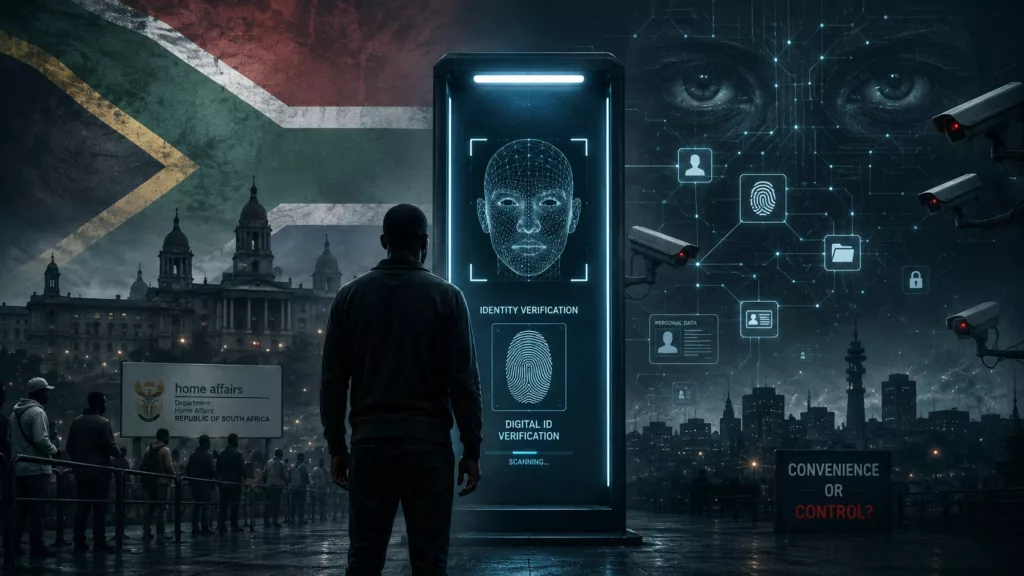
The Surveillance Questions Few Are Asking
Every government promises that new powers will only be used for the public good.
History tells a different story.
Across the world, governments have introduced measures in the name of efficiency, security and convenience, only for those same powers to expand far beyond their original purpose. Once the infrastructure exists, it rarely disappears. Instead, it grows, evolves and eventually becomes part of everyday life.
South Africa now stands at a similar crossroads.
The Department of Home Affairs’ proposed Digital Identity system is being promoted as a modern solution that will simplify identity verification and improve service delivery. On the surface, that sounds reasonable. Few people would object to faster government services or less bureaucracy.
But what happens when convenience comes at the cost of privacy?
What happens when a system built to verify identity can also record interactions, store personal information and eventually become the preferred gateway to banking, healthcare, employment and government services?
These are precisely the questions Lex Libertas believes South Africans should be asking before it is too late.
The organisation has now escalated its campaign by writing to every political party represented in Parliament, demanding that each publicly declare whether it supports or opposes the proposed Digital ID regulations.
Why?
Because this debate is no longer just about technology.
It is about power.
Lex Libertas argues that the draft regulations would create the framework for a system capable of logging Digital ID verification activity for at least seven years. Supporters may view this as necessary administration. Critics see something very different: the gradual construction of surveillance infrastructure that future governments could inherit and expand.
Governments change.
The powers they accumulate usually do not.
Perhaps even more concerning is the repeated assurance that participation will remain voluntary.
South Africans have heard similar promises before.
Time and again, systems introduced as optional have slowly become unavoidable. Banks adopt them. Employers begin requesting them. Service providers integrate them. Before long, citizens discover that saying “no” is technically possible, but practically impossible.
A voluntary system can become compulsory without Parliament ever passing another law.
Then comes the uncomfortable question that many South Africans are already asking.
Can the Department of Home Affairs be trusted to manage such an enormous responsibility?
This is the same department that has struggled with system failures, long queues, delayed documentation and repeated operational challenges. Citizens have spent years hearing that “the system is offline.” Yet the government now expects those same citizens to trust it with an even larger and more sophisticated biometric identity platform.
Trust is not something government can demand.
It is something it earns.
Lex Libertas also warns that the proposed regulations would place significant authority in the hands of the Director-General of Home Affairs with relatively limited independent oversight.
Some argue that current officials would never abuse such powers.
Perhaps they wouldn’t.
But constitutional safeguards are never written for the governments we trust. They exist because one day we may not trust those in power.
Perhaps the greatest mistake people make is assuming tomorrow’s government will think like today’s.
South Africa’s political landscape is changing rapidly. Coalitions are reshaping Parliament. Political alliances shift constantly. Leadership changes.
Yet once digital infrastructure exists, every future administration inherits it.
That is why this debate matters.
This is not simply about an app on your phone.
It is about building the infrastructure that could one day determine how citizens identify themselves, access services and interact with both government and private institutions.
Could that infrastructure always be used responsibly?
Possibly.
Could it also be expanded beyond its original purpose?
History suggests that possibility should never be ignored.
Lex Libertas has launched its Stop Digital ID campaign because it believes South Africans still have an opportunity to stop the current regulations before they become law. The organisation is also demanding that every political party tell voters exactly where it stands on the proposal instead of hiding behind carefully worded political statements.
If political parties believe Digital ID is necessary, they should say so openly.
If they oppose it, they should say that openly too.
Silence is no longer good enough.
The window for public participation will not remain open indefinitely. Once legislation is adopted and infrastructure begins rolling out, reversing course becomes significantly more difficult.
South Africans often complain after decisions have already been made.
This time, they still have a choice.
The question is whether enough people will use it.
Will convenience become the price paid for freedom? Is Digital ID simply overdue modernisation, or the first building block of something far more intrusive? If citizens remain silent while the foundations are being laid, will they still have the opportunity to object once the walls have been built?